

Solar Water Pump for Agriculture in Faisalabad: Costs, Sizes & Benefits in 2026
Farming needs dependable water, but irrigation can become expensive when you rely on grid electricity or diesel. A solar water pump for agriculture in Faisalabad offers another way to power irrigation during useful daylight hours.
Instead of buying fuel for every pumping cycle, a solar pumping system uses electricity produced by solar panels. The system can move water from a tube well, borewell, pond, or other water source to your fields.
However, choosing a solar pump is not simply about buying more panels. Water depth, pump capacity, flow rate, irrigation method, pipe size, and daily water demand all affect the final design.
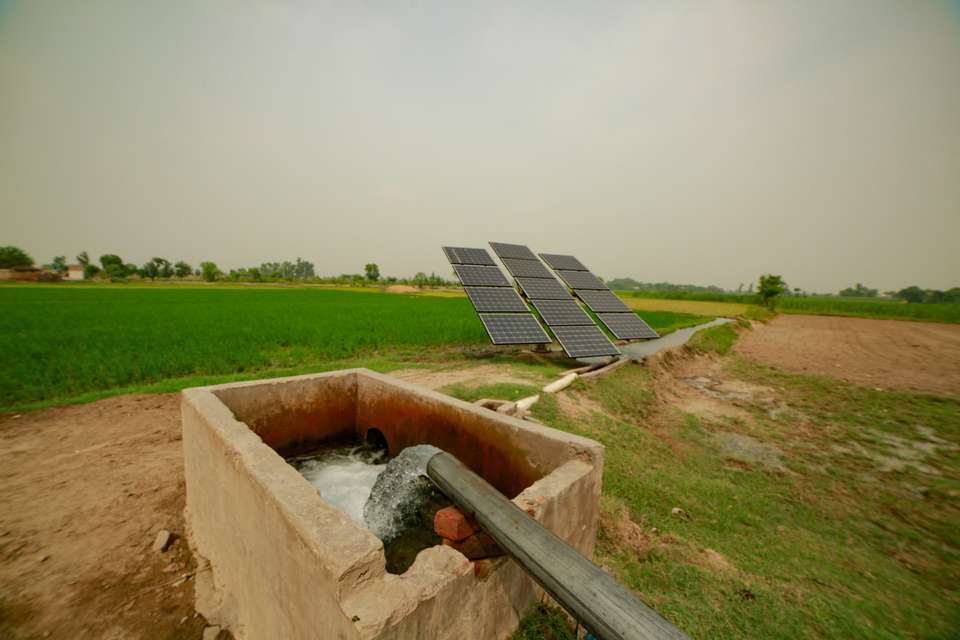
Real agricultural solar-pumping example in Pakistan. Image source: Welthungerhilfe.
What Is a Solar Water Pump for Agriculture?
A solar water pump is an irrigation system that uses solar electricity to operate a water pump. Solar panels generate electricity during daylight, while a suitable controller or inverter manages the power supplied to the pump.
The pump then moves water from its source toward the field, storage tank, pond, drip system, or sprinkler network. The exact setup depends on the farm and the amount of water required each day.
How Does a Solar Water Pump Work?
The process starts when sunlight reaches the solar panels. The panels produce electrical power, and the pump controller manages that power before sending it to the pump.
The pump lifts or pushes water through pipes toward the required location. In some farms, water goes directly to crops. In others, farmers store water during the day and use it later.
| Component | Main Purpose |
|---|---|
| Solar panels | Generate electricity from sunlight. |
| Solar pump controller | Controls electrical power supplied to the pump. |
| Water pump | Moves water from the source to the required location. |
| Pipes | Carry water to storage or irrigation points. |
| Mounting structure | Supports the solar panels safely. |
| Protection equipment | Helps protect the electrical system. |
Why Are Farmers Considering Solar Water Pumps in Faisalabad?
Irrigation can consume a significant amount of energy. Farmers using diesel pumps must repeatedly purchase fuel, while grid-powered pumps depend on electricity availability and applicable electricity costs.
Solar pumping changes the energy source. Once the system is installed, the panels generate electricity from sunlight instead of requiring a continuous fuel supply. Pakistan has documented real agricultural solar-pumping projects, including systems used for tube-well irrigation.
Solar Water Pump vs Electric Tube Well
An electric tube well uses grid electricity to run its pump. A solar pumping system can generate the required electricity from its own solar array during suitable daylight conditions.
Neither option is automatically right for every farm. You should compare the existing electrical connection, pumping schedule, water depth, required flow, installation cost, and long-term operating requirements.
| Factor | Solar Pump | Electric Tube Well |
|---|---|---|
| Main energy source | Solar electricity | Grid electricity |
| Daytime operation | Yes | Yes, when electricity is available |
| Fuel requirement | No diesel fuel | No diesel fuel |
| Grid dependence | Can be reduced | Required |
| Battery | Optional depending on design | Normally not required |
Solar Water Pump vs Diesel Pump for Farming
Diesel pumps can operate whenever fuel is available, which gives farmers flexibility. However, fuel purchases, engine servicing, oil changes, repairs, and transportation can add to operating expenses.
A solar pump works differently. Its strongest production period is normally during daylight. This makes water storage an important option when irrigation is needed outside solar production hours.
| Factor | Solar Pump | Diesel Pump |
|---|---|---|
| Energy source | Sunlight | Diesel fuel |
| Fuel purchases | Not required | Required |
| Engine maintenance | No diesel engine | Required |
| Night operation | Needs storage or another power source | Possible with fuel |
| Long-term operating model | Solar generation | Continuous fuel use |
What Size Solar Pump Do You Need for Your Farm?
Pump size should never be selected by acreage alone. Two farms with the same land area can require very different pumps because their water depth, crop needs, pipe distances, and irrigation systems may be different.
A proper assessment should consider water depth, total pumping head, required flow, pipe losses, irrigation method, daily water requirement, and expected pumping hours. This information helps determine the pump capacity and solar array size.
| Requirement | What Should Be Checked? |
|---|---|
| Water source | Tube well, borewell, pond, canal, or other source |
| Water depth | Static and operating water levels |
| Flow requirement | Required water volume per hour |
| Land area | Total area that needs irrigation |
| Crop type | Water requirements during different growth stages |
| Irrigation method | Drip, sprinkler, flood, or another method |
How Many Solar Panels Are Needed for an Agricultural Pump?
There is no universal number of panels for every agricultural pump. The required solar capacity depends on the pump's electrical demand, selected panel wattage, controller specifications, solar conditions, and expected system losses.
For this reason, farmers should not choose panels by simply matching a pump's horsepower to a random panel count. The solar array and pump controller need to be designed as a complete electrical system.
Can Solar Pumps Run Agricultural Tube Wells?
Yes. A properly designed solar system can operate a tube-well pump when the pump, solar array, controller, and water source are correctly matched.
Water depth becomes especially important for tube wells. A deeper source can require greater pumping energy, so the installer should measure the water conditions before recommending a system.
Solar Pump for Drip Irrigation
Solar pumping can work well with drip irrigation because both systems can be planned around controlled daytime water delivery. Drip irrigation sends water closer to plant root zones instead of distributing it across the entire surface.
The pump still needs to provide the required pressure and flow. A professional design should therefore consider the complete irrigation network rather than treating the pump and drip system as separate purchases.
Solar Pump for Sprinkler Irrigation
Sprinkler irrigation can also operate with solar pumping when the system provides enough pressure and flow. The required pump capacity depends on the number of sprinklers, pipe layout, elevation, and pressure requirements.
Choosing a pump without checking these details can result in weak water pressure or uneven irrigation. The complete field layout should be considered before installation.
How Much Does a Solar Water Pump Cost in Faisalabad?
There is no single fixed price for a solar water pump for agriculture in Faisalabad. The final investment depends on pump capacity, solar panel capacity, water depth, controller, structure, cables, pipework, installation, and irrigation requirements.
A small agricultural pumping system and a large tube-well installation can have very different equipment requirements. Farmers should therefore request a complete quotation instead of comparing only the price of the pump.
| Cost Factor | Why It Matters |
|---|---|
| Pump capacity | Larger pumping requirements can require larger equipment. |
| Solar panel capacity | Higher energy demand may require a larger solar array. |
| Water depth | Deeper water can increase pumping requirements. |
| Controller or inverter | Must match the pump and solar array. |
| Mounting structure | Depends on panel quantity and installation location. |
| Pipework | Changes according to distance, flow, and field layout. |
| Battery storage | May add cost when operation beyond solar hours is required. |
| Installation | Depends on site conditions and system complexity. |
Do Solar Water Pumps Need Batteries?
Not always. Many agricultural solar pumping systems can operate mainly during daylight and send water directly to the field or a storage tank.
Batteries become more relevant when the farm needs electrical operation outside solar production hours. In some cases, storing water during the day can be more practical than storing electricity in batteries.
Can a Solar Pump Work at Night?
Solar panels do not provide normal daytime-level generation at night. A direct solar pumping system therefore normally works during daylight when solar generation is available.
If night irrigation is important, the farm may use battery storage, grid backup, another energy source, or a water-storage tank. The right choice depends on the irrigation schedule and farm requirements.
What Affects Solar Pump Performance?
Solar pump performance can change with sunlight, shading, panel cleanliness, water level, pump condition, pipe losses, electrical connections, and system design.
A sudden drop in water output does not always mean the solar panels are the problem. The cause could be a blocked pipe, pump wear, dirty panels, electrical faults, changing water levels, or another component issue.
Solar Water Pump Maintenance
Solar pumping systems still need regular maintenance even though they do not use a diesel engine. Panels should be kept reasonably clean, electrical connections should be inspected, and the pump should be maintained according to its manufacturer's requirements.
Farmers should also monitor actual water output. A pump can continue running while delivering less water than expected. Regular checks make it easier to identify problems before they affect irrigation.
What Should Farmers Check Before Installing a Solar Pump?
Start with a proper site assessment. The installer should check the water source, water depth, required flow, field size, crop requirements, irrigation method, pumping schedule, solar exposure, and available installation space.
You should also request a written system specification. It should clearly identify the pump, solar panels, controller, protection equipment, structure, cables, installation work, warranty terms, and any additional irrigation equipment.
Solar Water Pump and High-Efficiency Irrigation
Solar pumping can become more useful when combined with an efficient irrigation method. Drip and sprinkler systems can help distribute water according to the field and crop requirements.
Punjab's agricultural water-management programs include high-efficiency irrigation and solar-related initiatives. This makes the combination of solar pumping and efficient irrigation an important area for farmers to understand.
Is Solar Pumping Suitable for Every Farm?
Solar pumping can be useful for many agricultural applications, but it is not automatically the right choice for every farm. Deep water sources, high pressure requirements, shading, limited installation space, or unusual pumping schedules can change the technical requirements.
The goal should not be to install the largest pump or the highest number of panels. The goal is to build a system that provides the required water at a practical operating cost.
Government Solar Irrigation Programs in Punjab
Punjab has introduced agricultural programs involving solarization and high-efficiency irrigation. Farmers interested in government support should always check the latest official requirements before making a financial decision.
Eligibility rules, application procedures, project areas, deadlines, and financial terms can change. Always verify current information through the relevant government department instead of relying on an old social media post or outdated advertisement.
Common Mistakes When Buying a Solar Water Pump
One common mistake is choosing a pump only by horsepower. Another is buying a solar array without checking whether its electrical specifications match the pump controller.
Some buyers also compare quotations only by price. A cheaper quotation may have different panel wattage, pump quality, controller specifications, protection equipment, installation standards, or warranty coverage.
How UA Solar Solutions Can Help With Agricultural Solar Pumping
Agricultural solar pumping should start with the farm, not with a fixed package. UA Solar Solutions can help assess the solar requirement around your actual site conditions, energy needs, and irrigation application in Faisalabad.
Before choosing equipment, discuss your water depth, pump capacity, irrigation area, daily water requirement, and expected pumping schedule. This approach helps create a system that is designed for the farm instead of simply selling a standard package.
Get your requirements reviewed before you purchase the pump, panels, or inverter.
Frequently Asked Questions About Solar Water Pumps
What is a solar water pump for agriculture?
It is a water-pumping system powered by electricity generated from solar panels. Farmers can use it to move water from tube wells, borewells, ponds, or other sources for irrigation.
Can solar water pumps work in Faisalabad?
Yes. Solar-powered agricultural pumping has been demonstrated in Pakistan, including Punjab. The correct system still depends on the farm's water source, pump requirement, and irrigation design.
Can a solar pump replace a diesel tube well?
A properly designed solar pumping system can reduce or replace diesel use for suitable applications. The decision depends on water depth, required flow, pumping hours, and the complete system design.
How many solar panels does a water pump need?
There is no universal number. Panel quantity depends on pump power, panel wattage, controller specifications, solar conditions, and expected system losses.
Does a solar water pump need a battery?
Not necessarily. Many systems can pump water during daylight and store that water for later use. Batteries may be useful when electrical operation is required outside available solar hours.
Can solar pumps run drip irrigation?
Yes. Solar pumping can be combined with drip irrigation when the pump provides the required flow and pressure. The complete system should be designed around the irrigation network.
How much does an agricultural solar pump cost?
The cost varies according to pump capacity, solar panel capacity, water depth, controller, mounting structure, cables, pipework, installation, and irrigation requirements.
How long does a solar water pump last?
Service life varies by pump type, equipment quality, installation conditions, operating hours, and maintenance. Different components also have different expected service lives.
Final Thoughts
A solar water pump for agriculture in Faisalabad can give farmers another way to power irrigation without depending completely on conventional energy sources. However, the system should be designed around actual water and farm requirements.
Water depth, flow rate, pump capacity, solar generation, irrigation method, pipework, and storage all matter. If you are planning an agricultural solar project, start with a proper site assessment instead of choosing equipment from price alone.
Explore Now
| Explore Now | Learn More |
|---|---|
| Solar Panel Installation in Faisalabad | Explore Solar Installation Guide |
| Solar Installation Services in Faisalabad | Explore Solar Services |
| Solar System Installation Cost | Explore Solar Cost Guide |
| UA Solar Solutions | Visit UA Solar Solutions |
Sources
| Source | Reference |
|---|---|
| Punjab Agriculture Department | Solar & Irrigation Information |
| Punjab Agriculture Department | Agricultural Tubewell Solarization |
| Pakistan Council of Research in Water Resources | Solar Powered Pumping Research |
| UNIDO | Pakistan's Farmers and Solar Power |
Image note: The agricultural images used in this article are illustrative published photographs from external sources. They are not represented as UA Solar Solutions customer projects.


